We’re excited to announce a new data citation API endpoint and are seeking your feedback. The new service makes existing data citation relationships in our metadata available, thereby surfacing this part of the research nexus. At the same time, we’ve decided that it’s time to move on from Event Data.
Metadata is communication; it can tell a story about research and paint a picture for others to respond to and learn from, across the world and throughout the forthcoming generations. Metadata can feel technical with words like ‘infrastructure’ and ‘schema’, and sometimes, like tech in general, it comes with hyperbole. But metadata really is part art (storytelling and pictures) and part science (structured models and standards) with both aspects being equally important, and requiring people as well as systems. That necessary combination of human and machine involvement also makes metadata challenging.
Once a year we release all metadata records for content registered with Crossref in a public data file. This year’s version, containing nearly 180 million records, is now available. It includes metadata associated with all Crossref-registered DOIs in JSON-lines format.
Crossref Ambassadors act as local points of contact, meeting editors, librarians, researchers, and institutions to help them navigate Crossref services and understand how strong metadata supports visibility, integrity, and trust in research. They explain how to participate in our rich network of connections between works, people, and institutions, in ways that make sense in their own contexts. And last year, being our 25th anniversary, Ambassadors also massively contributed to our celebrations!
Some small organisations who want to register metadata for their research and participate in Crossref are not able to do so due to financial, technical, or language barriers. To attempt to reduce these barriers we have developed several programs to help facilitate membership. One of the most significant—and successful—has been our Sponsor program.
Sponsors are organisations that are generally not producing scholarly content themselves but work with or publish on behalf of groups of smaller organisations that wish to join Crossref but face barriers to do so independently. Sponsors work directly with Crossref in order to provide billing, technical, and, if applicable, language support to Members.
This blog post is from Lettie Conrad and Michelle Urberg, cross-posted from the The Scholarly Kitchen. As sponsors of this project, we at Crossref are excited to see this work shared out.
The scholarly publishing community talks a LOT about metadata and the need for high-quality, interoperable, and machine-readable descriptors of the content we disseminate. However, as we’ve reflected on previously in the Kitchen, despite well-established information standards (e.g., persistent identifiers), our industry lacks a shared framework to measure the value and impact of the metadata we produce.
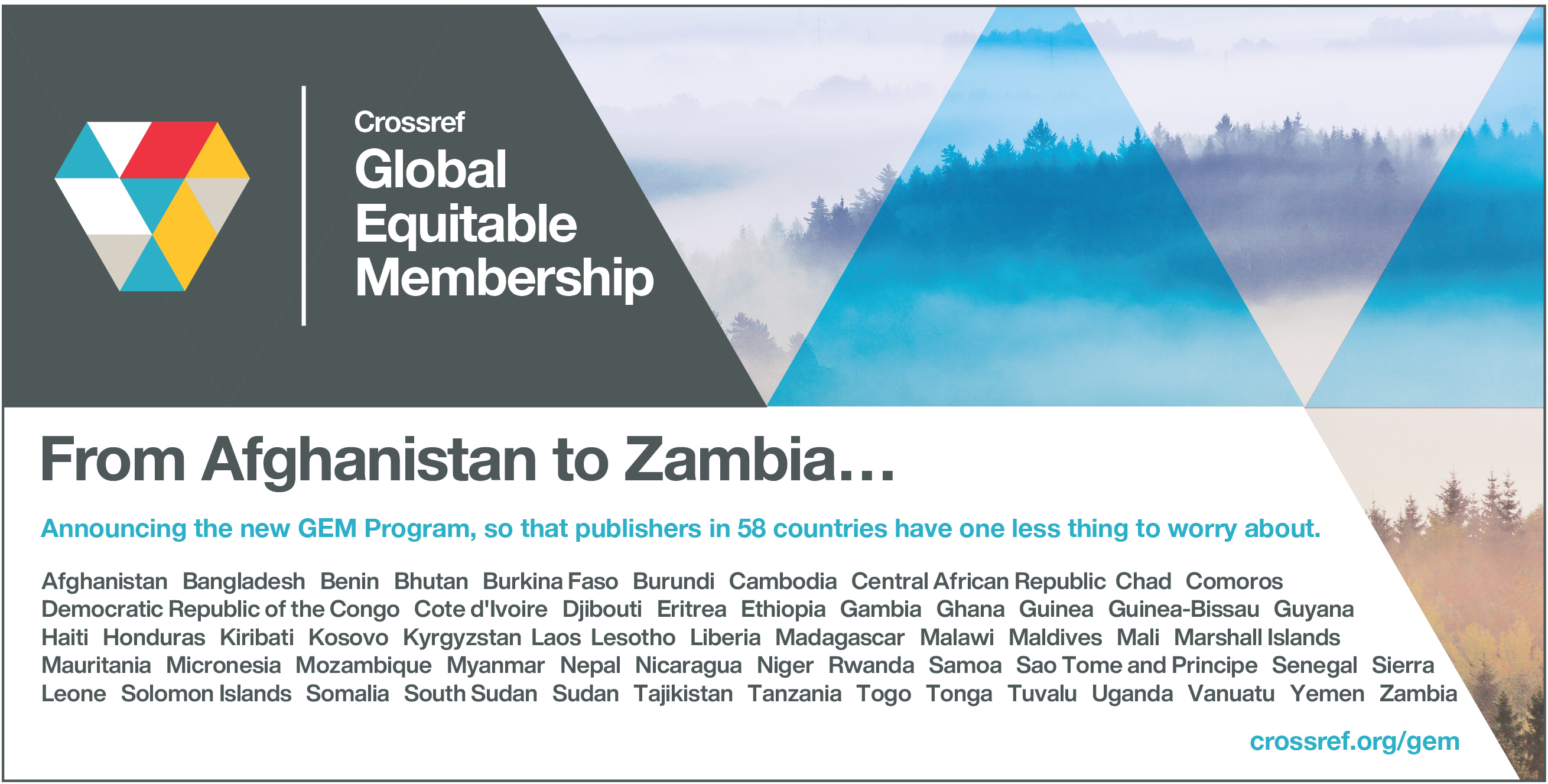
When Crossref began over 20 years ago, our members were primarily from the United States and Western Europe, but for several years our membership has been more global and diverse, growing to almost 18,000 organisations around the world, representing 148 countries.
As we continue to grow, finding ways to help organisations participate in Crossref is an important part of our mission and approach. Our goal of creating the Research Nexus—a rich and reusable open network of relationships connecting research organisations, people, things, and actions; a scholarly record that the global community can build on forever, for the benefit of society—can only be achieved by ensuring that participation in Crossref is accessible to all. Building a network for the global community must include input from all of the global community.
In August 2022, the United States Office of Science and Technology Policy (OSTP) issued a memo (PDF) on ensuring free, immediate, and equitable access to federally funded research (a.k.a. the “Nelson memo”). Crossref is particularly interested in and relevant for the areas of this guidance that cover metadata and persistent identifiers—and the infrastructure and services that make them useful.
Funding bodies worldwide are increasingly involved in research infrastructure for dissemination and discovery. While this post does respond to the OSTP guidelines point-by-point, the information here applies to all funding bodies in all countries. It will be equally useful for publishers and other systems that operate in the scholarly research ecosystem.
Preprints have become an important tool for rapidly communicating and iterating on research outputs. There is now a range of preprint servers, some subject-specific, some based on a particular geographical area, and others linked to publishers or individual journals in addition to generalist platforms. In 2016 the Crossref schema started to support preprints and since then the number of metadata records has grown to around 16,000 new preprint DOIs per month.
One of the things that makes me glad to work at Crossref is the principles to which we hold ourselves, and the most public and measurable of those must be the Principles of Open Scholarly Infrastructure, or POSI, for short. These ambitions lay out how we want to operate - to be open in our governance, in our membership and also in our source code and data. And it’s that openness of source code that’s the reason for my post today - on 26th September 2022, our first collaboration with the JSON Forms open-source project was released into the wild.
Ans: metadata and services are all underpinned by POSI.
Leading into a blog post with a question always makes my brain jump ahead to answer that question with the simplest answer possible. I was a nightmare English Literature student. ‘Was Macbeth purely a villain?’ ‘No’. *leaves exam*
In part one of our series on the Integrity of the Scholarly Record (ISR), we talked about how the metadata that our members register with us helps to preserve the integrity of the record, and in particular how ’trust signals’ in the metadata, combined with relationships and context, can help the community assess the work.
In this second blog, we describe membership eligibility and what you can and cannot tell simply from the fact that an organisation is a Crossref member; why increasing participation and reducing barriers actually helps to enhance the integrity of the scholarly record; and how we handle the very small number of cases where there may be a question mark.
The integrity of the scholarly record is an essential aspect of research integrity. Every initiative and service that we have launched since our founding has been focused on documenting and clarifying the scholarly record in an open, machine-actionable and scalable form. All of this has been done to make it easier for the community to assess the trustworthiness of scholarly outputs. Now that the scholarly record itself has evolved beyond the published outputs at the end of the research process – to include both the elements of that process and its aftermath – preserving its integrity poses new challenges that we strive to meet… we are reaching out to the community to help inform these efforts.
I’m pleased to share the 2022 board election slate. Crossref’s Nominating Committee received 40 submissions from members worldwide to fill five open board seats.
We maintain a balance of eight large member seats and eight small member seats. A member’s size is determined based on the membership fee tier they pay. We look at how our total revenue is generated across the membership tiers and split it down the middle. Like last year, about half of our revenue came from members in the tiers $0 - $1,650, and the other half came from members in tiers $3,900 - $50,000. We have four large member seats and one small member seat open for election in 2022.