Metadata is communication; it can tell a story about research and paint a picture for others to respond to and learn from, across the world and throughout the forthcoming generations. Metadata can feel technical with words like ‘infrastructure’ and ‘schema’, and sometimes, like tech in general, it comes with hyperbole. But metadata really is part art (storytelling and pictures) and part science (structured models and standards) with both aspects being equally important, and requiring people as well as systems. That necessary combination of human and machine involvement also makes metadata challenging.
Once a year we release all metadata records for content registered with Crossref in a public data file. This year’s version, containing nearly 180 million records, is now available. It includes metadata associated with all Crossref-registered DOIs in JSON-lines format.
Crossref Ambassadors act as local points of contact, meeting editors, librarians, researchers, and institutions to help them navigate Crossref services and understand how strong metadata supports visibility, integrity, and trust in research. They explain how to participate in our rich network of connections between works, people, and institutions, in ways that make sense in their own contexts. And last year, being our 25th anniversary, Ambassadors also massively contributed to our celebrations!
We have renewed our partnership with DOAJ to focus on a new set of objectives that reflect both organisations’ commitment to improving sustainable and equitable services and infrastructure. This renewed collaboration focuses on improving the quality of scholarly metadata while expanding support for journals in low- and middle income- countries.
We have worked together since 2021, primarily to encourage the dissemination and use of scholarly research using online technologies, and regional and international networks, partners and communities. This partnership has helped to build local institutional capacity and sustainability within the global scholarly communication ecosystem. A continued partnership also reflects that we have a shared community; currently almost 90% of DOAJ journals are represented in Crossref.
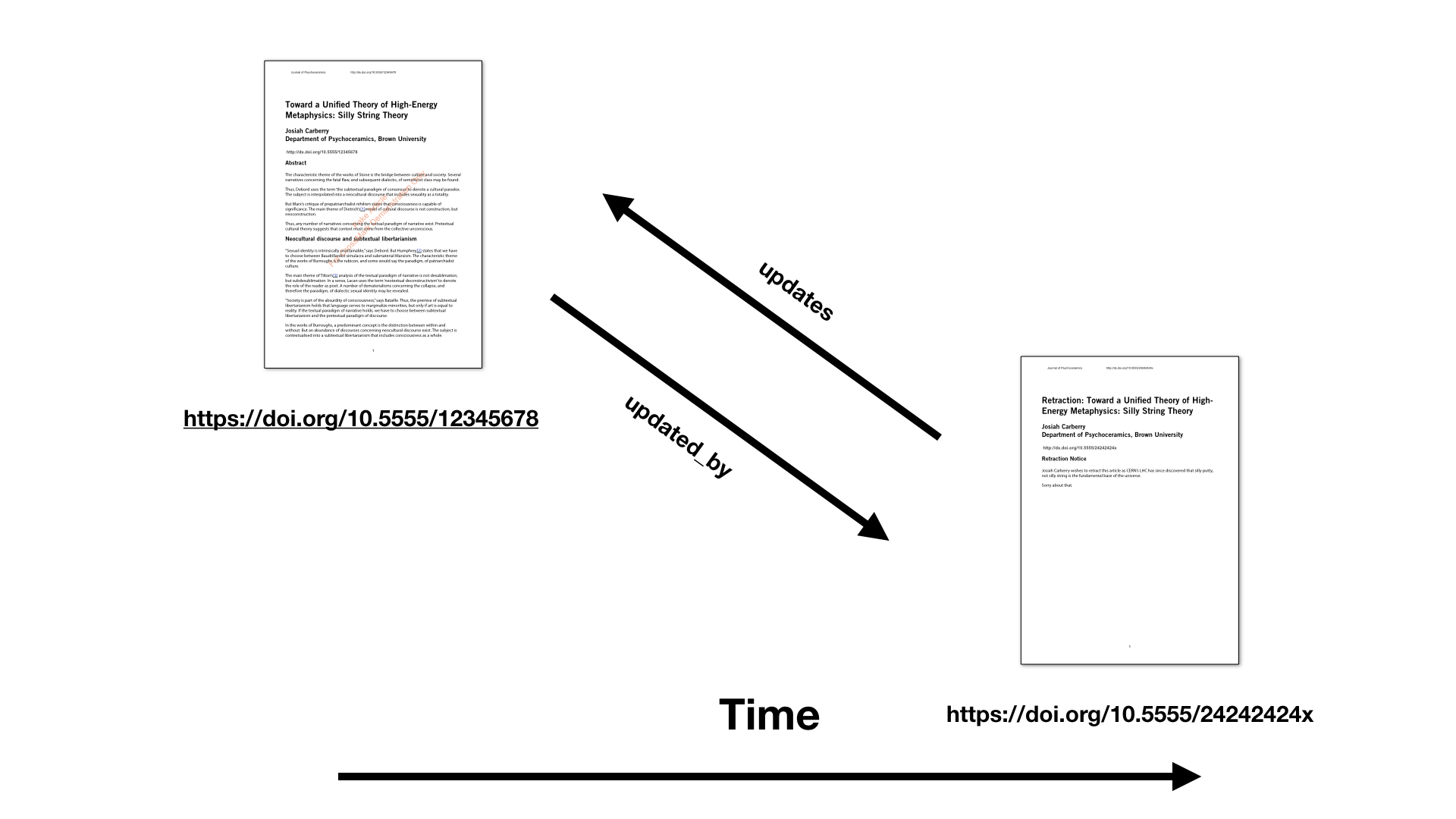
Typically, when an editorially significant update is made to a document, the publisher will not modify the original document, but will instead issue a separate document (such as a correction or retraction notice) which explains the change. This separate document will have a different DOI from the document that it corrects and will therefore have different metadata. This process is complementary to versioning.
In this example, article A (with the DOI 10.5555/12345678) is eventually retracted by a retraction notice RN (with the DOI 10.5555/24242424x). Each document has Crossmark metadata, but the fact that RN updates article A is only recorded in the RN’s Crossmark deposit. The Crossmark internal API has to tie the two documents together and indicate in metadata of the original document (A), that it has been updated_by the second document (RN).
The Crossmark part of the metadata schema is used to register updates, but this doesn’t mean that you need to have implemented other parts of Crossmark to deposit updates. In the examples below, in the <crossmark> section you can use only the <update> field in the deposit XML if you don’t usually deposit other Crossmark metadata.
Example 1: simple retraction
This is a simple example of article A being retracted by a retraction notice RN where both A and RN have Crossmark metadata deposited.
First, the PDF is produced and the XML deposited to Crossref.
This is a simple example of article B being corrected by a correction notice CN where both B and CN have Crossmark metadata deposited. The only real difference between this and the previous example is that we are creating a different kind of update.
When a member does not issue a separate update/correction/retraction notice and instead just makes the change to the document (without changing its DOI either), this is called an in-situ update. In-situ updates or corrections are not recommended because they tend to obscure the scholarly record. How do you tell what the differences are between what you downloaded and the update? How do you differentiate them when citing them (remember, we are only talking about “significant updates” here)? However, some members need to support in-situ updates, and this is how they can be supported.
Example 4: correction of article that has no Crossmark metadata deposited
If you deposit Crossmark metadata for a retraction or and update notice which, in turn, points at an article that does not have Crossmark metadata assigned to it, we will generate a “stub” Crossmark for the item being updated. The stub metadata will simply copy essential Crossmark metadata. This metadata can be queried via our API, but won’t activate anything on your site unless you add the Crossmark widget to the corresponding page of the item being updated.
Example 5: correction notice that corrected multiple documents
Sometimes members issue correction or clarification notices which provide corrections for multiple documents. This too can be supported by Crossmark. In the following example, one correction/clarification document provides updates to two documents (F and G)