Metadata is communication; it can tell a story about research and paint a picture for others to respond to and learn from, across the world and throughout the forthcoming generations. Metadata can feel technical with words like ‘infrastructure’ and ‘schema’, and sometimes, like tech in general, it comes with hyperbole. But metadata really is part art (storytelling and pictures) and part science (structured models and standards) with both aspects being equally important, and requiring people as well as systems. That necessary combination of human and machine involvement also makes metadata challenging.
Once a year we release all metadata records for content registered with Crossref in a public data file. This year’s version, containing nearly 180 million records, is now available. It includes metadata associated with all Crossref-registered DOIs in JSON-lines format.
Crossref Ambassadors act as local points of contact, meeting editors, librarians, researchers, and institutions to help them navigate Crossref services and understand how strong metadata supports visibility, integrity, and trust in research. They explain how to participate in our rich network of connections between works, people, and institutions, in ways that make sense in their own contexts. And last year, being our 25th anniversary, Ambassadors also massively contributed to our celebrations!
We have renewed our partnership with DOAJ to focus on a new set of objectives that reflect both organisations’ commitment to improving sustainable and equitable services and infrastructure. This renewed collaboration focuses on improving the quality of scholarly metadata while expanding support for journals in low- and middle income- countries.
We have worked together since 2021, primarily to encourage the dissemination and use of scholarly research using online technologies, and regional and international networks, partners and communities. This partnership has helped to build local institutional capacity and sustainability within the global scholarly communication ecosystem. A continued partnership also reflects that we have a shared community; currently almost 90% of DOAJ journals are represented in Crossref.
The depositor report is used for checking basic info about your DOI registrations.
Depositor reports list all DOIs by member and title for journals, books, and conference proceedings. We currently have depositor reports for journals, books, and conference proceedings (but not for other record types). The index page is updated weekly. Title-level reports are updated as your metadata is updated with us.
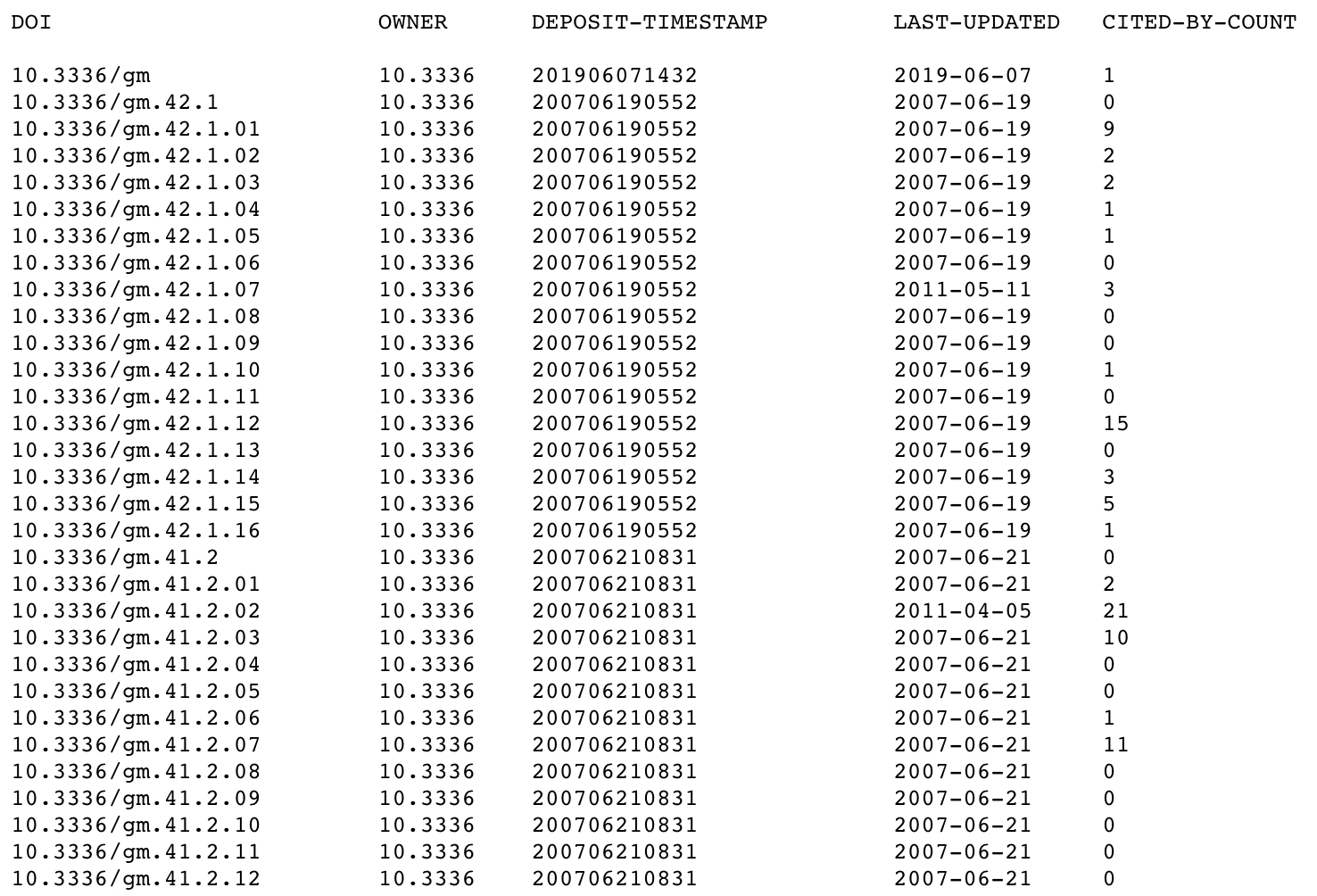
Each title-level report lists all DOIs registered for the title as well as (for each DOI) the owning prefix, the deposit timestamp, the date the record was last updated, and the number of Cited-by matches. To view each title-level report, select the member name then the appropriate title.
Field/missing metadata report: You can also see what basic bibliographic metadata fields are populated for your journal articles - click on the green triangle to the right of each member name to view a field / missing metadata report.
DOI crawler: We crawl a broad sample of journal DOIs to make sure the DOIs are resolving to the appropriate page. For each journal crawled, a sample of DOIs that equals 5% of the total DOIs for the journal up to a maximum of 50 DOIs is selected. You can access the crawler details for a given journal by selecting the linked date in the ‘last crawl date’ column.
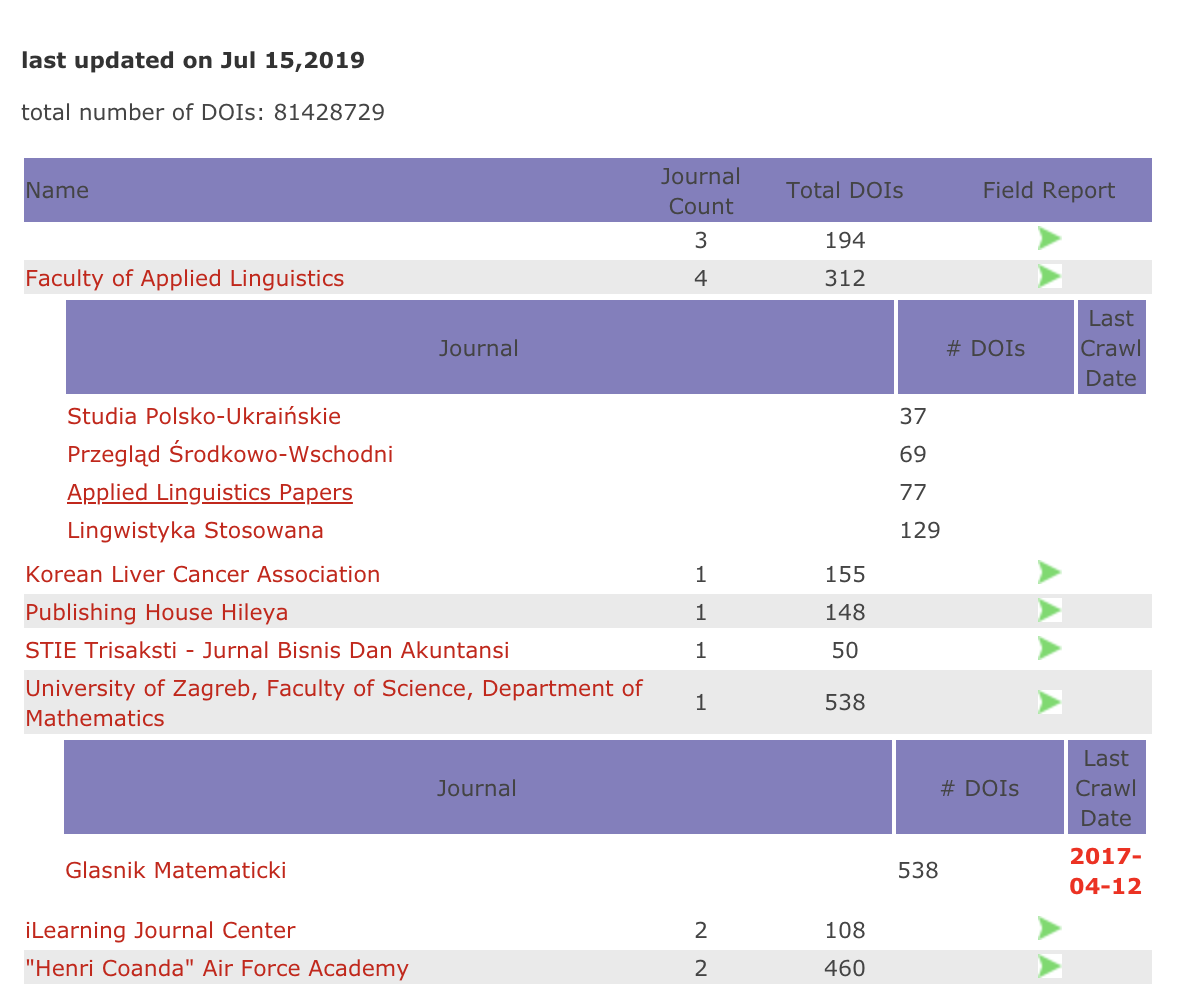
Click on a member name in the report, and you will see a list of that member’s titles below the name. Click on any publication title to open a text file which list all DOIs for that title.
The initial view shows:
Name: name of the member. Members with more than one prefix will appear multiple times
Journal/Book/Conf Proc count: number of journal, book, or conference proceeding titles associated with the member
Total DOIs: total number of DOIs deposited for the selected title
Field report: shows missing metadata fields for each member, select the icon to view
The expanded view shows:
Name of each journal, book, or conference proceeding with DOI names deposited by the member
DOIs: Total number of DOIs registered for each journal, book, or conference proceeding deposited by the member
Last crawl date: date of last crawler report (if available)
Depositor report title view
Select a journal, book, or conference proceeding title to retrieve a list of DOIs for the title (DOI), the owner prefix of the DOI (OWNER), the timestamp value for the DOI (DEPOSIT-TIMESTAMP) the date the DOI was last updated (LAST-UPDATED), and the number of Cited-by matches for the DOI:
Title-level depositor report data may also be retrieved using format=doilist - learn more about retrieving DOIs by title.
Page maintainer: Isaac Farley Last updated: 2024-July-19






 icon to view