Metadata is communication; it can tell a story about research and paint a picture for others to respond to and learn from, across the world and throughout the forthcoming generations. Metadata can feel technical with words like ‘infrastructure’ and ‘schema’, and sometimes, like tech in general, it comes with hyperbole. But metadata really is part art (storytelling and pictures) and part science (structured models and standards) with both aspects being equally important, and requiring people as well as systems. That necessary combination of human and machine involvement also makes metadata challenging.
Once a year we release all metadata records for content registered with Crossref in a public data file. This year’s version, containing nearly 180 million records, is now available. It includes metadata associated with all Crossref-registered DOIs in JSON-lines format.
Crossref Ambassadors act as local points of contact, meeting editors, librarians, researchers, and institutions to help them navigate Crossref services and understand how strong metadata supports visibility, integrity, and trust in research. They explain how to participate in our rich network of connections between works, people, and institutions, in ways that make sense in their own contexts. And last year, being our 25th anniversary, Ambassadors also massively contributed to our celebrations!
We have renewed our partnership with DOAJ to focus on a new set of objectives that reflect both organisations’ commitment to improving sustainable and equitable services and infrastructure. This renewed collaboration focuses on improving the quality of scholarly metadata while expanding support for journals in low- and middle income- countries.
We have worked together since 2021, primarily to encourage the dissemination and use of scholarly research using online technologies, and regional and international networks, partners and communities. This partnership has helped to build local institutional capacity and sustainability within the global scholarly communication ecosystem. A continued partnership also reflects that we have a shared community; currently almost 90% of DOAJ journals are represented in Crossref.
Pending publication is a way of creating a DOI and depositing metadata for a content item any time after a manuscript has been accepted but before it is published online. This is possible for all standard record types (such as articles, books, conference proceedings).
Because a pending publication has not yet been published, its DOI will resolve to a publicly-available Crossref-hosted landing page. Once the work is published online, this same DOI will resolve to the URL for that content.
The pending publication record type serves as a temporary placeholder for your content - like a “coming soon” or preview of the great work to come. For a pending publication, you register basic metadata for your content item before registering all the formal metadata that comes with a version of record. Take care not to share a DOI before it has been deposited with us, or it will not resolve for your readers, and will lead to a failed resolution in your resolution report. Learn more about the pending publication consultation.
Use cases for pending publication
Before the pending publication record type existed, we recommended you to register DOIs at the time content was published online, or shortly after. As the communication needs of our members (researchers, funders, institutions, and publishers) evolve, we have created this new solution to aid you and your work, and allow you to register DOIs before content is published online. With pending publication:
Members can:
address timing issues related to press embargos
publicly establish scholarly precedence for their articles
meet the conditions in full for new funder policies and mandates, which focus on acceptance as a key event to report on
ensure that institutional repositories use the DOI to link to the member-stewarded copy
Researchers can provide formal evidence of all publications in employment and grant applications
Funders can fully track all publications funded by their research grants
Institutions can fully track the scholarly output of their faculty members
Technology vendors that support scholarly research management can account for all outputs
How does pending publication work?
When registering your publication as pending there are two things you need to do:
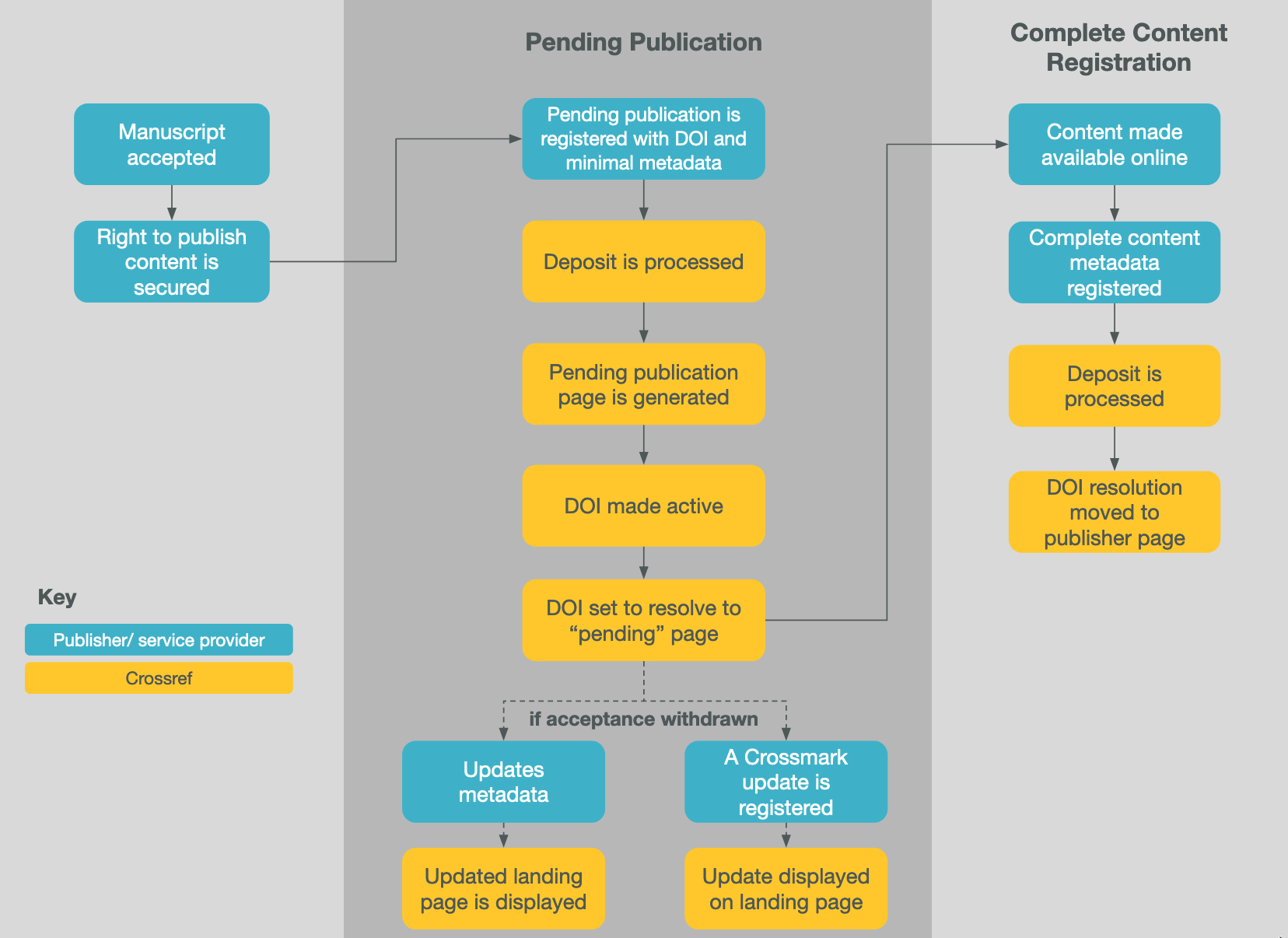
Register a subset of the metadata (as a minimum: member name, journal title, and accepted date) under the Pending Publication record type.
After you do this, the DOI will resolve to a Crossref-hosted landing page displaying your logo, a banner showing the manuscript has been accepted for publication, and the metadata you’ve provided. As with all registered content, pending publication metadata will be publicly available in our XML API (and updated as you update your metadata records). Unfortunately, we do not yet support pending publications in our REST API.
Once your work is published, you need to register the full metadata for the work - this is not an automatic process. You must update the metadata for each pending publication DOI, so that each DOI will resolve directly to the content (and not the pending publication landing page).
Pending publication workflow diagram
Crossmark participants please note that you can deposit Crossmark metadata at any point, but during the Beta version of the pending publication rollout, the Crossmark badge will not be displayed to readers.
Fees for pending publications
Content Registration (metadata deposit) fees still apply, but there are no additional fees for using pending publication. So, you’ll be charged once when you register the pending publication, but any subsequent updates, including the update on publication, are not charged.
History
Pending publication has been supported since 2019 and was designed in response to community feedback: