Metadata is communication; it can tell a story about research and paint a picture for others to respond to and learn from, across the world and throughout the forthcoming generations. Metadata can feel technical with words like ‘infrastructure’ and ‘schema’, and sometimes, like tech in general, it comes with hyperbole. But metadata really is part art (storytelling and pictures) and part science (structured models and standards) with both aspects being equally important, and requiring people as well as systems. That necessary combination of human and machine involvement also makes metadata challenging.
Once a year we release all metadata records for content registered with Crossref in a public data file. This year’s version, containing nearly 180 million records, is now available. It includes metadata associated with all Crossref-registered DOIs in JSON-lines format.
Crossref Ambassadors act as local points of contact, meeting editors, librarians, researchers, and institutions to help them navigate Crossref services and understand how strong metadata supports visibility, integrity, and trust in research. They explain how to participate in our rich network of connections between works, people, and institutions, in ways that make sense in their own contexts. And last year, being our 25th anniversary, Ambassadors also massively contributed to our celebrations!
We have renewed our partnership with DOAJ to focus on a new set of objectives that reflect both organisations’ commitment to improving sustainable and equitable services and infrastructure. This renewed collaboration focuses on improving the quality of scholarly metadata while expanding support for journals in low- and middle income- countries.
We have worked together since 2021, primarily to encourage the dissemination and use of scholarly research using online technologies, and regional and international networks, partners and communities. This partnership has helped to build local institutional capacity and sustainability within the global scholarly communication ecosystem. A continued partnership also reflects that we have a shared community; currently almost 90% of DOAJ journals are represented in Crossref.
Setting up your iThenticate 2.0 account MTS integration (admins only)
Documentation Menu
Setting up your iThenticate 2.0 account MTS integration (admins only)
This section of our documentation is for Similarity Check account administrators who plan to access iThenticate 2.0 through their Manuscript Submission System (MTS).
If you are using iThenticate v1 rather than iThenticate 2.0, take a look at the section for v1 account administrators.
If you intend to use iThenticate 2.0 directly in the browser (and not through an integration with your Manuscript Submission System (MTS) please skip to the section on setting up iThenticate 2.0 for browser users for iThenticate administrators.
Your personal administrator account in iThenticate 2.0
Once Turnitin has enabled iThenticate 2.0 for your organisation, the main editorial contact provided on your application form will become the iThenticate account administrator.
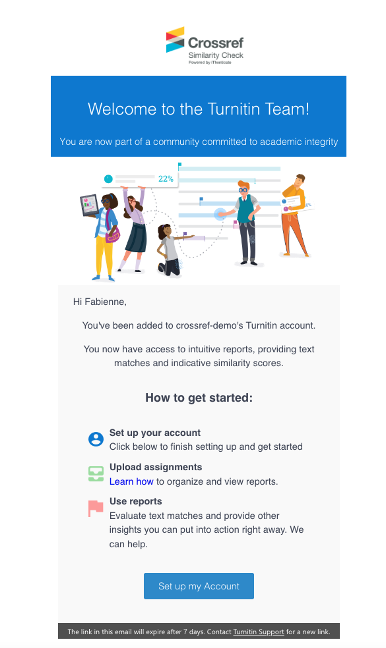
You will receive an email from Turnitin with a link to set your credentials. The email will look like this:
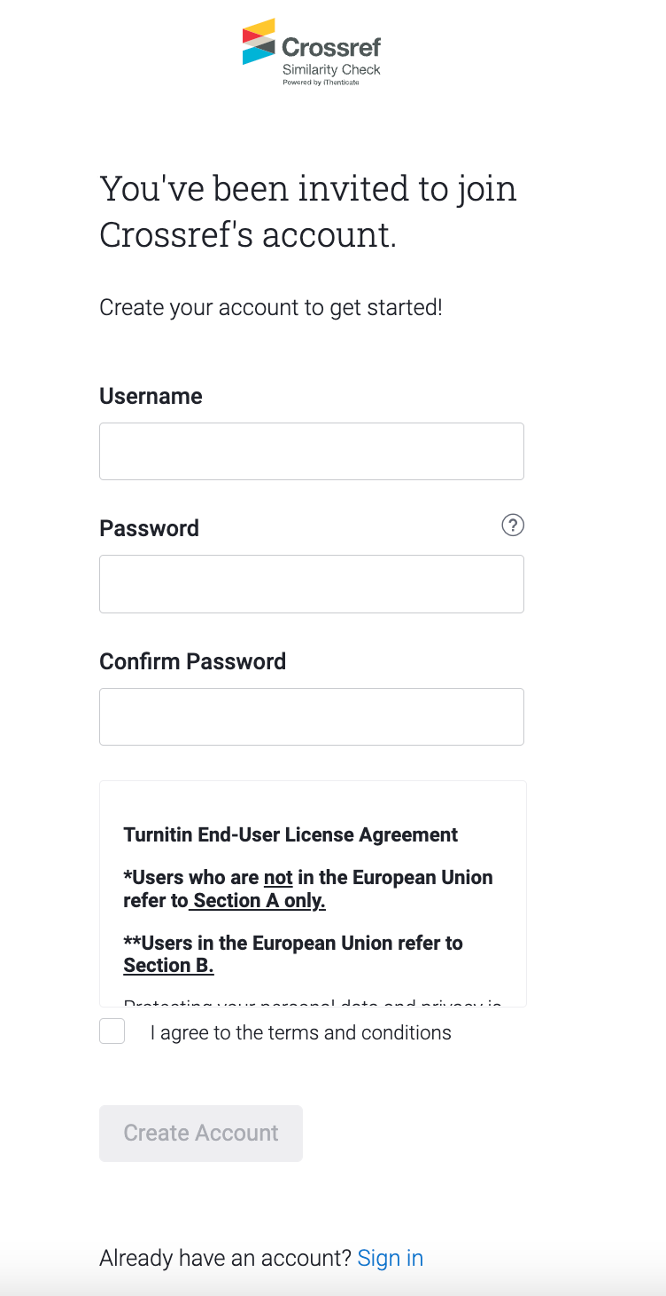
Click on the blue ‘Set up my account’ button at the bottom of the email. This will bring you to a page which looks something like this:
Fill out your username and password, and don’t forget to tick to agree to the terms and conditions. You will then arrive at your new iThenticate 2.0 account.
How do you know if you’re an account administrator?
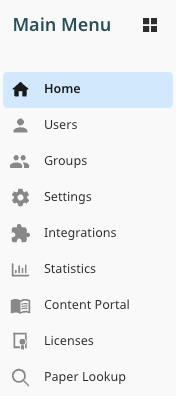
When you are logged in to iThenticate, what tabs can you see?
If you’re using iThenticate 2.0, you will only be able to see Users on the menu if you’re an account administrator.
So if you can’t see Manage Users or Users, you’re not an account administrator, and you can just read the user instructions for iThenticate 2.0 on the Turnitin website.
Updating your email address, username or password in the future
If you need to change your personal email address, username or password in the future, you can find instructions on the Turnitin website.
If you forgot your password and have never signed into your new 2.0 account, you’ll need to reach out to Turnitin’s support to have your password resent to you from Turnitin.
If you’ve already signed into your 2.0 account, but can’t remember your password, you can simply use the Forgot Password link on the login screen of your unique 2.0 website (https://crossref-xxx.turnitin.com, with xxx being your member ID).
Page maintainer: Amanda Bartell Last updated: 2022-July-15